Seven major Japanese automakers are expected to see their net profit drop by 48% in the 2026 fiscal year compared with the historical peak.
On May 20, citing the Nikkei Asia Review, Japan’s automobile manufacturing industry is facing a sharp profit shrinkage, with profits in the 2026 fiscal year (April 2026 to March 2027) likely to be nearly halved.
The report states that seven major Japanese automakers—Toyota, Honda, Nissan, Suzuki, Mazda, Subaru, and Mitsubishi Motors—are projected to achieve a total net profit of 3.9 trillion yen (equivalent to approximately 24.5 billion US dollars) in the 2026 fiscal year. This figure represents a significant 48% decline from the historical high of 7.54 trillion yen (equivalent to approximately 47.4 billion US dollars) in the 2023 fiscal year, a decrease of 3.64 trillion yen (equivalent to approximately 22.9 billion US dollars).
However, the sharp profit shrinkage of the seven major Japanese automakers in the 2026 fiscal year is not a short-term accidental fluctuation, but a continuation and amplification of the industry’s operational difficulties in the previous fiscal year.
In the 2025 fiscal year (April 2025 to March 2026; different enterprises may use different names, which are uniformly referred to as the 2025 fiscal year below), the profitability of major Japanese automakers continued to weaken, with many incurring losses.
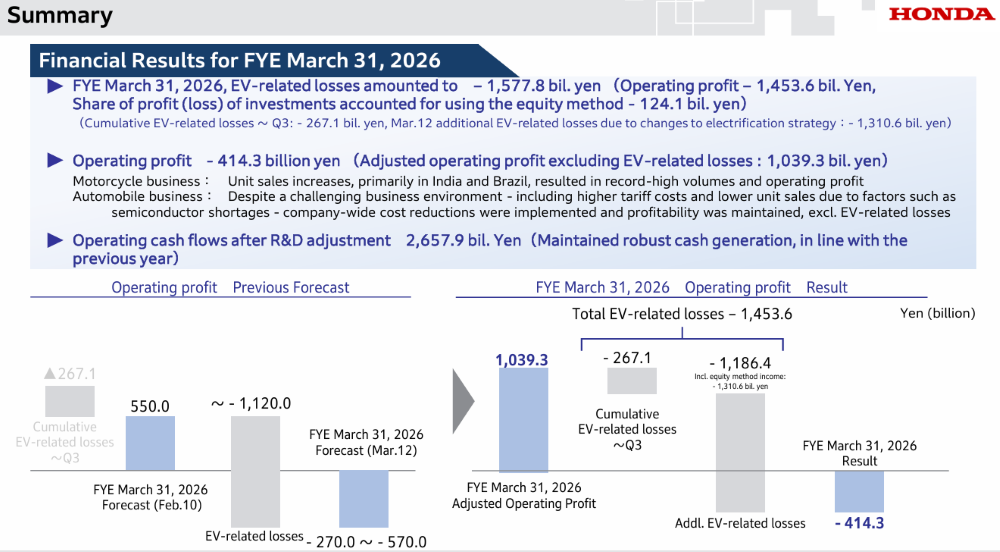
Among the three major Japanese automakers, Honda reported its first loss since its listing nearly 70 years ago, with a loss of 414.3 billion yen (equivalent to approximately 2.60 billion US dollars), compared with a profit of 835.8 billion yen (equivalent to approximately 5.25 billion US dollars) in the same period of the previous year.
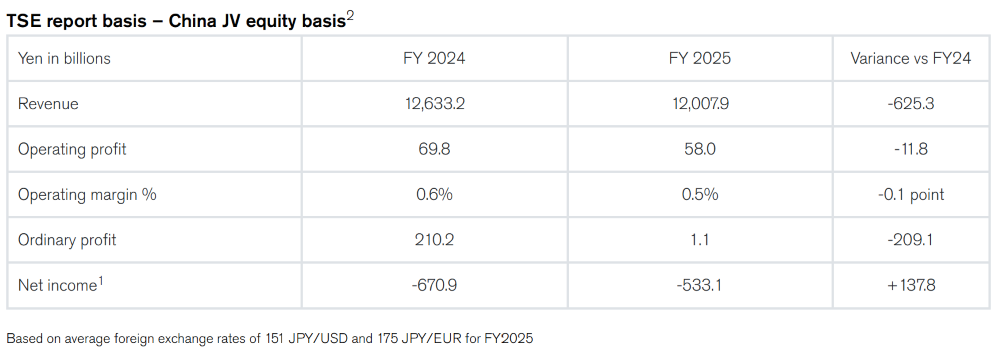
Nissan suffered a loss of 533.1 billion yen (equivalent to approximately 3.35 billion US dollars) in the 2025 fiscal year, a narrowing from the loss of 670.9 billion yen (equivalent to approximately 4.22 billion US dollars) in the 2024 fiscal year, but it still recorded huge losses for two consecutive years.
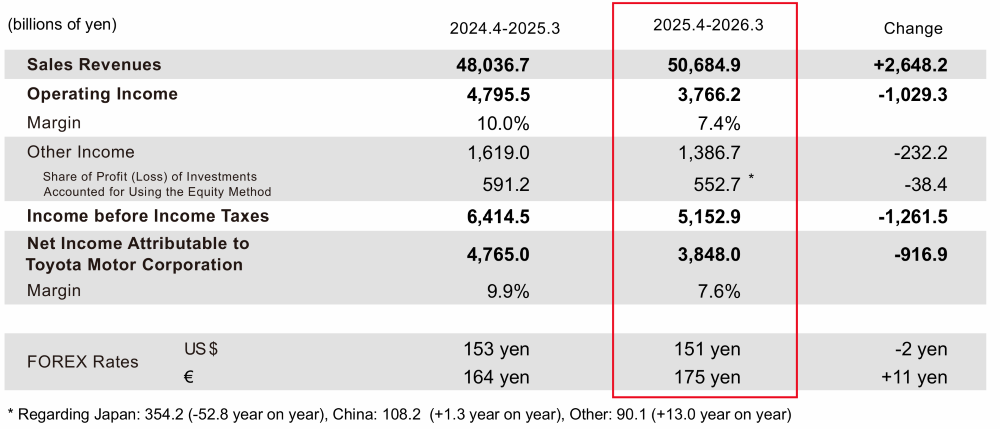
Toyota’s net profit in the 2025 fiscal year was 3.85 trillion yen (equivalent to approximately 24.2 billion US dollars). Although it did not incur a loss, it decreased by about 916.9 billion yen (equivalent to approximately 5.76 billion US dollars) year-on-year compared with the net profit of 4.77 trillion yen (equivalent to approximately 30.0 billion US dollars) in the 2024 fiscal year, a year-on-year decline of 19.2%.
Among the other three automakers—Mazda, Subaru, and Mitsubishi Motors—their net profits in the 2025 fiscal year dropped by 69.2%, 73%, and 76% respectively compared with the 2024 fiscal year. Among the seven major Japanese automakers, only Suzuki’s net profit attributable to parent increased by 5.6% in the 2025 fiscal year.
Faced with the severe predicament of a cliff-like drop in profits and drastic changes in the industry competition pattern, seven major Japanese automakers including Toyota, Honda, and Nissan have successively tightened their business strategies.
Toyota mentioned in the Q&A session of its 2025 fiscal year financial report that it will accelerate the delivery of hybrid models, streamline model variants to avoid excessive complexity, and shift from “laying the foundation” to “improving efficiency”. It will work with suppliers to rebuild a sustainable profit system instead of setting specific numerical targets.
Honda previously announced the cancellation of the R&D and market launch of three original pure electric models planned to be produced in North America, and will re-evaluate its electrification strategy. At the same time, some executive directors of Honda voluntarily returned part of their monthly salaries for the fiscal year.
Nissan will continue to implement the Re:Nissan strategy, and continue to drive sales and profitability through cost reduction, production optimization, and more targeted new energy-driven strategies in China.
In general, the intertwined pressures of continued performance decline, weak global demand, and electrification transformation have plunged Japan’s automobile industry into a transformation pain. The subsequent effectiveness of new energy transformation and the pace of recovery in global terminal sales will directly determine whether Japanese automakers can get out of the profit trough.