
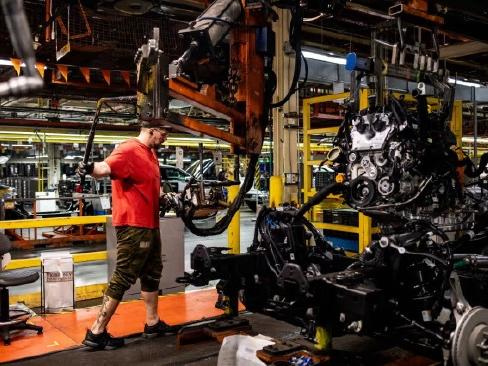
Negotiators from the Trump team have proposed that half of a vehicle’s parts and raw materials must be produced in the United States; the current USMCA does not set a specific U.S. content requirement.
The Trump administration plans to propose new regulations stipulating that vehicles must contain 50% U.S.-sourced parts to qualify for low tariffs under the USMCA.
According to sources familiar with the matter, the Trump administration intends to amend the USMCA to require that half of the parts and raw materials in automotive products be sourced from the United States in order to qualify for the agreement’s low-tariff provisions.
The new rules would significantly increase the percentage of U.S.-sourced parts in automotive products under the agreement. The current agreement requires that 75% of a vehicle’s materials be produced in North America, but it does not specify a separate threshold for U.S. domestic content.
Sources indicate that this new proposal is part of the preparation for USMCA renegotiations. The agreement, signed by Trump in 2020, is due for review this year. A U.S. delegation arrived in Mexico City this week to begin the first round of formal consultations with Mexican officials.
This proposal represents the U.S. side’s initial position in negotiations with Mexico and may be adjusted in the coming months as talks progress.
According to other sources, the U.S. also plans to raise the required percentage of North American-sourced parts for automotive products, exceeding the current 75% standard.
The negotiations are being led by U.S. Trade Representative Jameson Greer; neither a spokesperson for his office nor a spokesperson for the Mexican government would comment on the matter.
Most automakers are skeptical of the proposal for a 50% U.S. domestic parts content requirement. If the transition period is short, it will be difficult for automakers to source half of their parts from the United States. In contrast, domestic labor unions such as the United Auto Workers have expressed support for the proposal, arguing that the rule is expected to create jobs and boost labor demand.
Under current rules, vehicles that meet regional parts content requirements are generally eligible for duty-free treatment under the USMCA. However, it remains uncertain whether this near-zero-tariff policy will continue following the renegotiation of the agreement. Grill has previously stated that the revised agreement will likely impose certain tariffs on Mexico and Canada.
Grill and other Trump administration officials have publicly expressed their hope that the agreement’s revision will bring more automotive production capacity back to the United States. Sources familiar with the matter say that this proposal regarding the percentage of U.S. and North American parts is a supporting measure aimed at promoting the reshoring of manufacturing.
Reuters had previously reported that the U.S. planned to introduce specific requirements for domestic parts, but the 50% threshold is being disclosed for the first time.
Trump has publicly threatened to withdraw from the USMCA. The agreement was negotiated and concluded during his first term to replace the old NAFTA. Grill has also proposed a plan to split the trilateral agreement into two bilateral agreements between the U.S. and Mexico, and between the U.S. and Canada. Some overseas automakers have already warned the U.S. that if the trilateral agreement cannot be maintained and they can no longer enjoy low or zero tariffs, they may stop supplying affordable models to the U.S. market.
Negotiations between the U.S. and Mexico began this Thursday and continued on Friday; the next round of talks is scheduled for next month in Washington, D.C., with the third round set to resume in Mexico City in July. The U.S. has not yet begun formal negotiations with Canada.
For automakers with factories in Mexico that primarily sell their products to the U.S. market, meeting the 50% U.S. parts content requirement is no easy task, and the challenge will be even greater if the new regulations are implemented quickly.
Federal data shows that, taking the GMC Terrain SUV assembled in Mexico as an example, only 11% of the vehicle’s total parts value comes from the U.S. and Canada, while core components such as engines and transmissions are mostly produced in Mexico.

