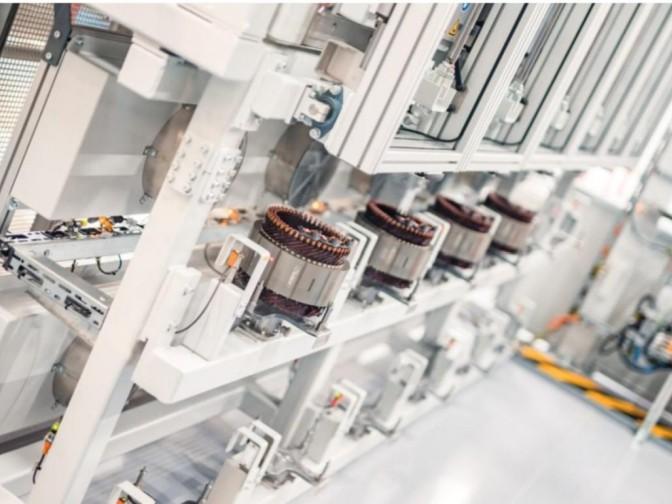
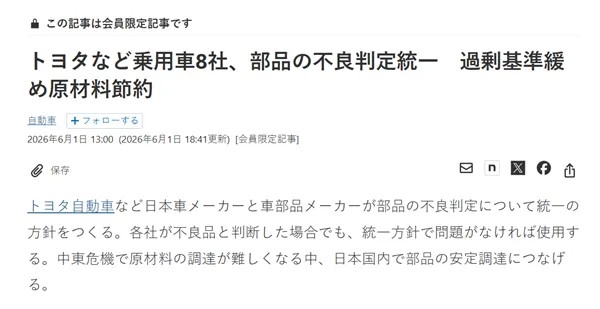
According to Japanese media reports, the Japan Automobile Manufacturers Association will jointly establish unified standards for determining parts defects. Minor imperfections that do not affect functionality and are difficult to detect after assembly will no longer be classified as defective and will be used directly in production.
This marks the first time the Japanese automotive industry has uniformly relaxed quality standards, with the immediate cause being difficulties in procuring raw materials due to the crisis in the Middle East.
It is understood that the new standards are being jointly developed by the Japan Automobile Manufacturers Association (JAMA) and the Japan Auto Parts Industries Association (JAPIA). JAMA includes eight passenger car companies such as Toyota and Honda, as well as truck and bus manufacturers, while JAPIA covers approximately 450 parts companies. Both organizations plan to gradually implement the new standards for various types of parts by the end of 2026.
The core change lies in the following: previously, when parts manufacturers discovered small black spots or imperfections on the surface, they would often independently classify the parts as defective and scrap them, even if they functioned perfectly normally.
Under the new standards, as long as parts meet national standards and have no major functional or cosmetic issues, automakers will accept them.
Taking plastic components used to connect automotive electronic devices as an example, approximately 60% of defects were previously attributed to the presence of black spots. With the unified standards, it is estimated that 10,000 fewer parts will be scrapped monthly in Japan, while inspection times will be reduced. Headlight components with small air bubbles can also be used as long as their function and appearance are unaffected.
The immediate catalyst for this shift is the deteriorating situation in the Middle East. Japanese automakers rely on the Middle East for 70% of their processed aluminum and naphtha imports. Following the blockage of the Strait of Hormuz, prices for raw materials used in plastics and interior components have skyrocketed, and the risk of supply disruptions has intensified. Reducing scrap rates and improving raw material efficiency have become urgent priorities for the industry’s survival.
Deeper pressures stem from competition from Chinese electric vehicles. Leveraging advantages in access to domestic raw materials and lower costs, Chinese parts manufacturers are rapidly eroding the market share of Japanese suppliers.
Listed Japanese parts manufacturers saw their net profits plummet by 35% in fiscal year 2025, while labor costs have risen by 20% over the past decade, leaving them clearly behind in cost competitiveness. Toyota has established a dedicated organization to conduct joint defect assessments with parts suppliers based on unified standards and to promote these new standards among partner small and medium-sized enterprises.
Japanese manufacturing has long been renowned for its “extreme quality control.” Whether this unified relaxation of defect standards represents a pragmatic move or a lowering of quality standards remains to be seen by the market.